Monday, May 10, 2010

What I Learned at the NJ Young Author’s Conference.


The New Jersey Young Authors Conference is a chance for elementary school students (aka the “young authors”) to talk with us, um, older authors.  This year, I was thrilled that I was invited to participate.

Since my presentation was for young writers, I came up with ten rules for writing and had the first letter of each rule spell out the expression “work it out”.  A friend reminded me that I had come up with an “acrostic” device.  Cool. Right?  I was all set to try it out.

The room was crowded -- packed with fourth graders and their parents. But I was ready. I had my props ( slinkies, a kickball, a July 20, 1969 newspaper) and of course, I had my trusty PowerPoint presentation. 

Sometimes when I get nervous, I forget words (admittedly, not a good trait for either a writer or a speaker).  The moment my school librarian host introduces me, the word “acrostic” slips away.

I wonder what will happen when I get to the “Work it Out” part of my presentation, and I try to recall as many multi-syllabic “a” words as I can.

Agnostic. Anagrammatic. Achromatic.

The intro is over. It's my turn. I begin talking about my book. But I’m thinking…

Acoustic.  Acetic.

I’m talking about the importance of stories now.

Anastatic. Anachronistic. Acrobatic.

It’s time to move into the “Rules for Writing”. When “Work It Out” comes up on the PowerPoint, my librarian host writes it lengthwise on easel paper (for the student to fill in the rules).

I am out of “a” words.  There’s nothing left in my brain. So I decide to ask the audience.

“Does anyone know the word for when the first letters in each line form a word or message?”

I look at the parents for help.  Some shrug. A few look away.  I look at the fourth graders. About a dozen hands shoot up.  “Acrostic” they say in unison.

“That’s it!” I say, and I feel saved.  I’m able to move on with the rest of my talk. 

That day, I learned what I already knew. That fourth graders are smart, interested in writing and know some pretty fancy words.

Monday, April 19, 2010

Earth Day Quotes


Here are some quotes to celebrate Earth Day!

"A society grows great when old men plant trees whose shade they know they shall never sit in." -- Greek proverb

"Earth laughs in flower."-- Ralph Waldo Emerson

 "No occupation is so delightful to me as the culture of the earth, and no culture comparable to that of the garden."-- Thomas Jefferson

"What is a weed? A weed is a plant whose virtues have not yet been discovered." -- Emerson

"He who plants a tree, plants a hope."

"Flowers are the sweetest things God ever made, and forgot to put a soul into."-- Henry Beecher

“A morning-glory at my window satisfies me more than the metaphysics of books.”  -- Walt Whitman


”Nature has no mercy at all. Nature says, “I’m going to snow. If you have on a bikini and no snowshoes, that’s tough. I am going to snow anyway.”  --Maya Angelou

“I will be the gladdest thing under the sun. I will touch a hundred flowers and not pick one.” –Edna St. Vincent Milay

“You are a child of the universe, no less than the trees and the stars; you have a right to be here.” –Desiderata

“To sit in the shade on a fine day and look upon the verdant green hills is the most perfect refreshment.” – Jane Austin 

“When one tugs at a single thing in nature; he finds it attached to the rest of the world.” – John Muir


Want to win a wonderful book and get $40 dollars in donated in your name to an organization that plants trees?  Head on over to Alison Formento's blog.  She’s giving away a copy of her new book, This Tree Counts! It’s a perfect book for celebrating Earth Day. To enter, all you have to do is tell her the name of your favorite tree. She'll also donate $40 to American Forests in the winner's name.


Thursday, April 8, 2010

Who do you write for?


The answer seems obvious. Whether you write middle grades, YAs or picture books, you’re aiming for a very specific demographic. But when you’re writing, do you think “hey, this book will amuse and delight ten-year-olds everywhere”, or do you write with a specific person in mind?

In his book On Writing, Stephen King said that he believed that “every novelist has a single ideal reader; that at various points during the composition of a story, the writer is thinking ‘I wonder what he/she will think when he/she reads this part?’” King went on to say that his ‘ideal reader’ is his wife, Tabitha. That is one of the most romantic things I’ve ever read. He wrote all those scary creepy stories for the love of his life.

It makes me feel a little guilty. My husband is supportive of my writing in a million different ways. He was the first person to ever call me an author (and that was after I wrote the first sentence of my first story.) But he doesn’t share my passion for middle grade books and he doesn’t read many of them. And I feel that having a basic understanding of the genre in which you are writing is a non-negotiable prerequisite for an ‘ideal reader’. So while my husband will celebrate my accomplishments, build me up when I’m anxious and listen to me read the same paragraph over and over again, he’s not the person I have in mind when I write.

Elizabeth Gilbert wrote her latest book, Committed: A Skeptic Makes Peace with Marriage, for twenty-seven women. After coming to the conclusion that she could never satisfy the millions of readers of her best seller Eat, Pray, Love, she narrowed it down her small circle of female friends. She even named them in her forward. Sure, whittling it down from millions to 27 is a huge feat, but I can’t imagine writing while thinking about 27 of my nearest and dearest friends. It would be hard to keep them all in my head. Besides, they all have such definite personalities. I wonder, at what point, my loved-ones would start to argue about the direction to take the story. Would they come to a consensus about a single sentence? Twenty-seven is way too many. For me, it needs to be one.

I have trusted readers whose opinions I cherish. Sometimes it’s a writing buddy, other times it’s my school librarian friend who has read every single piece of drivel I’ve ever written (if that’s not a definition of true friendship, I don’t know what is), other times it’s my nephew (he’s grown now, but he was a boy when I started writing).

For my work-in-progress, my ideal reader is a person I will never see again.
I met her on the release day for Neil Armstrong is my Uncle. I spent the day at a school visit celebrating with 4th and 5th graders. It was quite a party. Ice Cream. Cards. Banners. When the day was done, I sat in the classroom alone waiting for the teacher (aka my sister) to do an errand somewhere in the school. I was so tired I put my head on the desk. When I picked it up, a 5th grader was standing in front of me.

I’d met so many children that day that I couldn’t remember her name. I know she told it to me more than once. I was too embarrassed to ask. I wondered how long she’d been standing there.
What’s your next book about?” she asked.
I decided to be cagey. “What do you think it should be about?”

It was the question she was waiting for. She talked about two of the characters in my book. She wondered what happened to one of them. And she talked about friendship. She even gave me ideas for plots and themes. Then she put her hands on her hips. “And that,” she said, “is the story you should write next.”

Before I could ask her a single question she raced for the door.
While my w.i.p. has different characters than the ones she suggested, I keep her themes in mind. I still think about how confidently she spoke and how quickly she got to what was important. And when I write, I think of her. And I wish I could remember her name.

Wednesday, March 31, 2010

How the Food Network is Messing Up My Internal Editor


There’s a show called Chopped on the Food Network. Four up-and-coming chefs compete for $10,000 by cooking a three-course meal. In the beginning of each course, the chefs open up a basket of ingredients.  They have 30 minutes to use all the ingredients in a single dish.  The basket is always filled with a crazy combination of food like strawberries, turkey and gummy bears or coconut, calamari and doughnuts.  Yet somehow the chefs manage to take the odd combo and create a flavorful dish.
Three celebrity chef judges make comments while they cook (and of course they judge their work at the end).  After each course one of the chefs is chopped from the competition (It’s not as gruesome as it sounds. There are no knives involved. Instead, they uncover a tray. The chef whose dish is on the tray is asked to leave. Tim Allen, the host, says “You’ve been chopped.”).
It’s amazing how a really nice incentive (a chance to show off their talents to the TV viewing world not to mention the ten grand), a tight deadline (they have 30 minutes) and a very odd framework (those weird mystery ingredients) inspires them to come up with some pretty fancy meals.  I’m not sure exactly, but there’s some sort of inspirational recipe hidden in this incentive/deadline/framework mixture. Get it right and you can cook up all sorts of creative things (Sorry for the bad puns).
I’m not thrilled with the judges. Sure, it’s a competition. Three get chopped. One can win.  But they rarely say nice things. And they could. When a chef is able to combine tofu, blueberries and oysters and yet still remain true to his Caribbean roots, they could say something positive. Or how about a “hey, good job” when a chef makes the 30 minute deadline even after she messes up her first attempt and has to prepare the whole dish over again.
Instead they make comments like, “Look at him! He’s walking away from the calamari! It will turn to rubber if it’s overcooked!”  “This plate is a mess.  Did you see these drips on the side?” or my favorite nasty comment that one particular judge is fond of saying after the tasting “This food is not pleasing to me. I’m finding it inedible.”
I watch this show so much that now when I cook, I imagine the Chopped judges doing a commentary.
“Look at how uneven those pepper slices are.”
“Doesn’t she know how to plate a dish?  This food is a mess.”
And even though I know that this is taking conversations I have with myself to an amazing new level, sometimes I answer back.
“It’s 8:00pm on a Wednesday night. I’m making real food. And we are not eating popcorn for dinner.”
Recently I’ve begun to hear the Chopped voices when I write.   “This sentence is a mess.  Did you see these dangling modifiers?” or  “This paragraph is not pleasing to me. I’m finding it unreadable.”
Great. So now my internal editor sounds like the one of the judges on Chopped.
It’s time to turn off the TV or, at the very least, it’s time to watch a new show. Does anyone know what time Paula Deen is on?

Sunday, March 21, 2010

Do you have an Ikigai?


About a week ago my co-worker (and librarian extraordinaire) Kathy found this post-it note on her computer. 
"Do you know what it means?" she asked. 
I looked at the letters and tried to think of every possibility. Was it an abbreviation? A clue? Some new library jargon? (that was my best guess, because the good people who come up with library-type terminology are always thinking of new exciting phrases)
I shrugged.
"Did you notice who put this here?" she asked.
And even though my desk is a mere six feet away from Kathy's, I was clueless.
So Kathy turned to Meg, who is six feet away from her on the other side.  
Meg, an endless source of knowledge when it comes to interesting random things,  knew right away. "Ikigai. That's a Japanese word for "life's passion" or "the reason for existing".  Finding your ikigai is a journey, but a rewarding search that leads to lifelong satisfaction."
"And do we know who wrote this?" I asked. 
Meg shook her head.
For Kathy's sake, I hoped that the person who put the note on her pc didn't mean it as another task for her "to do" list.  This one would be a major project and she's already got her hands full. 
Perhaps it was a note from a library patron.  Maybe someone needed help finding their ikigai. (After a few years of fielding questions at the reference desk, nothing would surprise me).
We still don't know who put it on Kathy's desk or why, but it got me thinking. Do I have an ikigai?
We did a little research and found some interesting facts.  A recent seven-year study of tens of thousands of Japanese adults showed that those who said they had a ikigai significantly outlived those who did not. It seems that having a life's purpose is essential to our well-being. That sounds like a decent reason to continue the search.
So...
I tried to think of what mine would be. At first, I thought about the people I love. Hey, this ikigai stuff is a no brainer. There's nothing more important than having satisfying relationships. We all want that. But I think the need to build connections with others is one of the traits that makes us human. Since it's a common desire for all people (or most people), can it be an ikigai? There's no reason for a lifelong search if it's the same thing for everyone. We can tell small children, put it into the fifth grade curriculum (and then add it into the tenth grade just to reinforce it). Your life's purpose is your relationships.  We could do worse, but maybe we need to dig deeper. We all interact with each other in our own unique way. Maybe it has to do with how we see the world? Perhaps it's also something more.
I thought about writing.  I've given writing a lot of thought since I've been published. (It seems I enjoy having a philosophical crisis with every major milestone).  Is the act of writing enough? Do I need to get published? Is it a simply a creative outlet? Yes, I feel a deep desire to write. I hope to be published again. No matter what my publishing future holds, I can't imagine not writing. But is it my ikigai?
I'm also a librarian. There's so much about being a librarian that I love -- seeking out information, being a literacy advocate, doing research, helping people, etc.  But if this is my ikigai, then why do I feel compelled to write?
A few days ago, I thought I found the answer. I tasted this amazing homemade caramel topped with the perfect amount of coarse sea salt.  One mouthful and I decided my life's purpose would travel the world in search of salty sweet caramel treats.  I had found my ikigai. But I wondered if that would get old after a few years (oh but what a sweet few years).
 I'm still searching for my ikigai.  There are times when I think it will remain illusive, but then there are other moments when I can't help thinking..I'm getting close.

(btw, if you already found your ikigai, let me know)   


Saturday, March 13, 2010

The Day I Let My Dog Jump On the Bed


The only place in the entire house where my dog, Chi, is not allowed is on my bed. Of course, that means it's her favorite spot.
I can always tell she's been there. She has a special way of rearranging the pillows. She dumps the pretty decorative ones on the floor. (My husband's not fond of those either).
Chi doesn't even try to hide her behavior. If I find her on the bed, she stays put until I tell her to leave. When she jumps down, she makes it clear she's not happy. Her protests are always the same. She paces and shakes her collar. She sighs. She tosses her head up in the air and says "rooo rooo rooo".
A few days ago, I'm sitting on the bed reading, when she jumps up. Instead of going through our usual routine, I very softly say "just this once". I even pet her to let her know I'm serious.
While I go back to my book, she curls up on the corner of the bed, staring at me. I read a few chapters, trying to ignore her watching my every move.
The moment my stretched out leg accidentally touches her, she jumps off the bed and starts her protests.
"That's not what happened," I tell her. "I didn't chase you. You were able to stay this time."
She begins to pace.
"You're creating this situation. You decided it was going to go bad before it did."
I pat her spot, inviting her back. "It's okay. Really."
She's too busy doing her head toss to listen.
"That's why you were staring at me. You were expecting the worst. It didn't have to be this way. You could have stayed."
She answers with a deep and strangely human-sounding sigh.
There's no way she's getting back on that bed.
Poor Chi. She made up her mind about how things were going to be, and was unable to accept change -- even when it was a positive one.
Sometimes, I'm like that too. I think we all are. We assume a certain outcome based on what's happened in the past.
Old patterns are hard to break. But if we expect the same end result, it will happen over and over again. Chi inspired me. I'm going to try to release old expectations and see what the future will bring. Who knows, maybe I'll end up in a place I never expected to be.


Tuesday, March 2, 2010

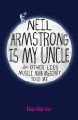
Neil Armstrong is My Uncle is an Honor Recipient of a Golden Kite Award


Years ago when I first started to write, two friends got together and gave me a year's membership to the Society of Children's Book Writers and Illustrators. I'm not sure, but I think I cried. This was an I-believe-in-you-and-in-your-dreams gift, and gifts like that always make me cry.

The SCBWI opened up a world to me. Through it, I found my first critique group (and my next one), learned about writing and the book industry; was inspired; met writing buddies (many turned into great friends);
became part of a wonderful community of writers and illustrators; realized that I wasn't the only one who wanted to be an author; learned that it's really hard to write a book and even harder to get it published; discovered that it's not impossible.

Last night, I got a call from Sara Rutenberg, the SCBWI Golden Kite Award coordinator, saying that Neil Armstrong is My Uncle was a 2010 honor recipient. How wonderful to receive an acknowledgment from an organization that means so much to so many writers and illustrators. (A note to Sara: sorry for rambling incoherently and for not being able to put two sentences together during our phone conversation.)

Below is a copy of the announcement listing the winners and honor recipients.


Monday, March 01, 2010

The Society of Children's Books Writers and Illustrators is pleased to announce the winners and honorees of the 2010 Golden Kite Awards (for books published in the 2009 calendar year.) The Golden Kite Award is the only award presented to children’s book authors and artists by their peers.

Golden Kite Award Winners

Fiction
SEA OF THE DEAD
by Julia Durango

Simon & Schuster Books for Young Readers
Nonfiction
ASHLEY BRYAN: WORDS TO MY LIFE'S SONG
by
Ashley Bryan
Atheneum Books for Young Readers (Simon & Schuster)
Picture Book Text
THE LONGEST NIGHT
b
y Marion Dane Bauer, illustrated by Ted Lewin
Holiday House
Picture Book Illustration
GRACIAS THANKS
Illustrated by John Parra, written
by Pat Mora
Lee & Low Books


Golden Kite Honor Recipients

Fiction
NEIL ARMSTRONG IS MY UNCLE
by Nan Marino

Roaring Book Press
Nonfiction
ERNEST HEMINGWAY: A WRITER'S LIFE
by Catherine Reef

Clarion Books (Houghton Mifflin Harcourt)
Picture Book Text
BELLA & BEAN
by Rebecca Kai Dotlich, illustrated by Aileen Leijten

Atheneum Books for Young Readers (Simon & Schuster)
Picture Book Illustration
BAD NEWS FOR OUTLAWS
Illustrated by R. Gregory Christie, written by Vaunda Micheaux Nelson

Carolrhoda Books

Here's the link to the SCBWI announcement For more information on all SCBWI awards and grants, please visit the Awards & Grants section of our website.